


Building an effective business case for employee recognition is a critical step in implementing employee rewards and recognition programs.
1. HR teams must build a compelling business case by citing critical research data and aligning the program with business goals and organizational values to secure approval for an employee recognition program.
2. Emphasize that the program does not need to be expensive, focusing on timely and frequent recognition rather than high-cost rewards.
3. Clearly outline the projected benefits, estimated costs, and ROI, demonstrating how the program can enhance employee engagement, retention, and overall business success.
4. Present case studies from other organizations to provide real-world examples of successful programs and their positive impact on business outcomes.
The impact of employee recognition is well known. Despite this, every organization seeking to establish such a program must justify the investment internally. Hence, the HR team must develop a compelling business case for employee recognition to secure the necessary funding and approvals.
Also read: Common Misconceptions about Employee Recognition Platforms.
| Key Aspects | Best Practices | Potential Impact |
|---|---|---|
| Define Clear Objectives | Align the recognition program with measurable business goals such as retention, productivity, engagement, and innovation | Enables clear ROI tracking and stronger leadership buy-in |
| Link Recognition to Business Outcomes | Connect recognition to KPIs like employee performance, customer satisfaction, and revenue growth | Demonstrates direct impact on profitability and organizational performance |
| Use Data and Research to Support the Case | Leverage internal data, industry benchmarks, and engagement studies to validate the need for recognition programs | Improves credibility and increases chances of executive approval |
| Quantify ROI and Cost Savings | Measure impact through reduced turnover, improved productivity, and cost savings from retention | Recognition programs can significantly reduce attrition and improve financial performance |
| Highlight Cost of Inaction | Showcase the financial and cultural cost of disengagement, attrition, and low productivity | Strengthens urgency and makes the investment case more compelling |
| Secure Executive Buy-In Early | Engage leadership with clear, data-backed insights and align expectations on outcomes and success metrics | Drives smoother implementation and higher program adoption |
| Align with Organizational Values and Culture | Tie recognition to company values, behaviors, and cultural priorities | Reinforces desired behaviors and strengthens organizational culture |
| Adopt a Structured Program Design | Combine formal, informal, and real-time recognition approaches for balanced coverage | Ensures consistency, inclusivity, and sustained engagement |
| Leverage Technology and Automation | Use digital platforms for real-time recognition, analytics, and seamless integration with workflows | Improves scalability, adoption, and ability to measure impact |
| Establish Measurement Frameworks | Track metrics like engagement scores, turnover rates, productivity, and participation levels | Enables continuous improvement and proof of ROI |
| Benchmark Budget and Investment Levels | Allocate an optimal budget per employee to maximize impact without diminishing returns | Proper investment significantly improves engagement and business outcomes |
| Use Case Studies and Success Stories | Present real-world examples of recognition driving measurable outcomes | Makes the business case tangible and relatable for stakeholders |
| Continuously Optimize the Program | Gather feedback, analyze data, and refine the program regularly | Ensures long-term effectiveness and sustained ROI |

First, the HR Team should cite critical research data to justify the investment to management.
The following data on employee recognition from research studies can prove helpful:
According to the findings of a survey, 69% of the participating employees accepted that being rewarded and recognized motivated them to continue with their current employer.

28% of employees have acknowledged the recognition from their immediate superiors as the most powerful form of recognition.

The results of research by Gartner have revealed that positive peer feedback can help in enhancing employee performance by 14%.

Another study has shown that frequent recognition boosts retention considerably as 63% of employees surveyed said that they were not likely to seek another job option within the next 3-6 months due to receiving frequent recognition.

Overall, the lack of a proper employee rewards program is one of the primary reasons for the decline in employee engagement.
Disengaged employees can have a significant financial impact on the company.
The HR team needs to build a solid business case for employee recognition by presenting verifiable facts and evidence.
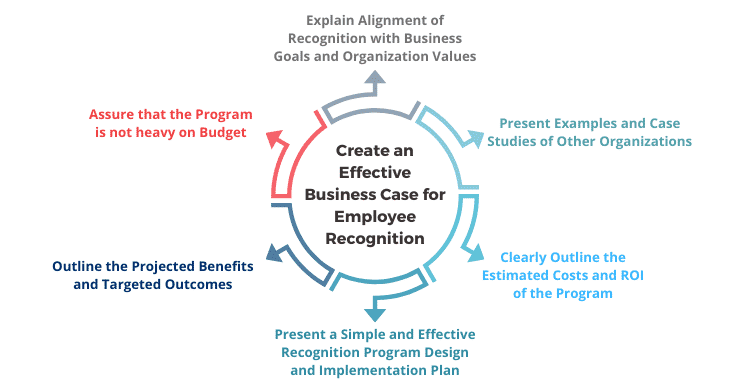
1. Explain the Alignment of Recognition with Business Goals and Organizational Values
2. Assure that the Program is Not Heavy on Budget
3. Outline the Projected Benefits and Targeted Outcomes
4. Present a Simple and Effective Recognition Program Design and Implementation Plan
5. Clearly Outline the Estimated Costs and ROI of the Program
6. Present Examples and Case Studies of Other Organizations

Every organization sets some short-term and long-term goals for its employees to achieve.
These may include increasing brand awareness, achieving specific business milestones, or fostering stronger customer relationships.
Hence, aligning these goals with the recognition program makes employees feel connected with the success of the business and motivates them to drive outstanding business results.
Aligning recognition with organizational values also helps build the desired work culture, which can provide long-term benefits.

Most organizations oppose implementing an employee recognition program because they believe it would be too expensive.
The HR teams need to emphasize the importance of providing timely and frequent recognition rather than it being of high monetary value.
A simple thank-you note for a job well done, or an extra day off, can be a highly effective way to recognize employees.

The team should highlight the projected benefits and targeted outcomes of making employee recognition integral to the HR strategy.
The focus should be on how the program will impact the business and how it is likely to enhance employee engagement and commitment toward the organization.
Overall, the significant role of such programs in boosting talent retention rates and building a strong employer brand to attract great talent from the market is also critical.

HR teams should thoroughly research the business’s needs and the workforce’s needs.
They should present a simple and effective program design and implementation plan to their management.
Employee recognition platforms are available in the market that can make implementing employee recognition programs extremely simple, cost-effective, and result-oriented.
Hence, the organization must assess the features and functionality of these platforms, align them with the program’s needs, and ensure smooth integration with existing systems.

Importantly, presenting an estimate of overall costs and expected returns is essential to build a strong business case.
Therefore, management can utilize this information to comprehend the program’s financial benefits and long-term implications.

Additionally, HR Teams should also try to present case studies of other organizations that have benefited from such programs.
Case studies of industry peers would have an added advantage.
Moreover, they could also share case studies of failed programs and lessons learned to provide a balanced perspective.
Building an effective business case for employee recognition by clearly articulating its benefits is a critical step for HR teams to secure approval from their management to implement employee recognition programs in their organizations.

Lead author: Sagar Chaudhuri, the Co-Founder and CEO of HiFives. He is an HR Tech Evangelist with over 25 years of experience in both corporate and entrepreneurial settings. Previously, Sagar has held leadership roles with companies such as Genpact, Infosys, and ICICI Bank. He has an engineering degree from IIT Kharagpur and an MBA from IIM Lucknow. Connect on LinkedIn
To stay updated on the latest HiFives blogs, follow us on Twitter (@MyHiFives)